
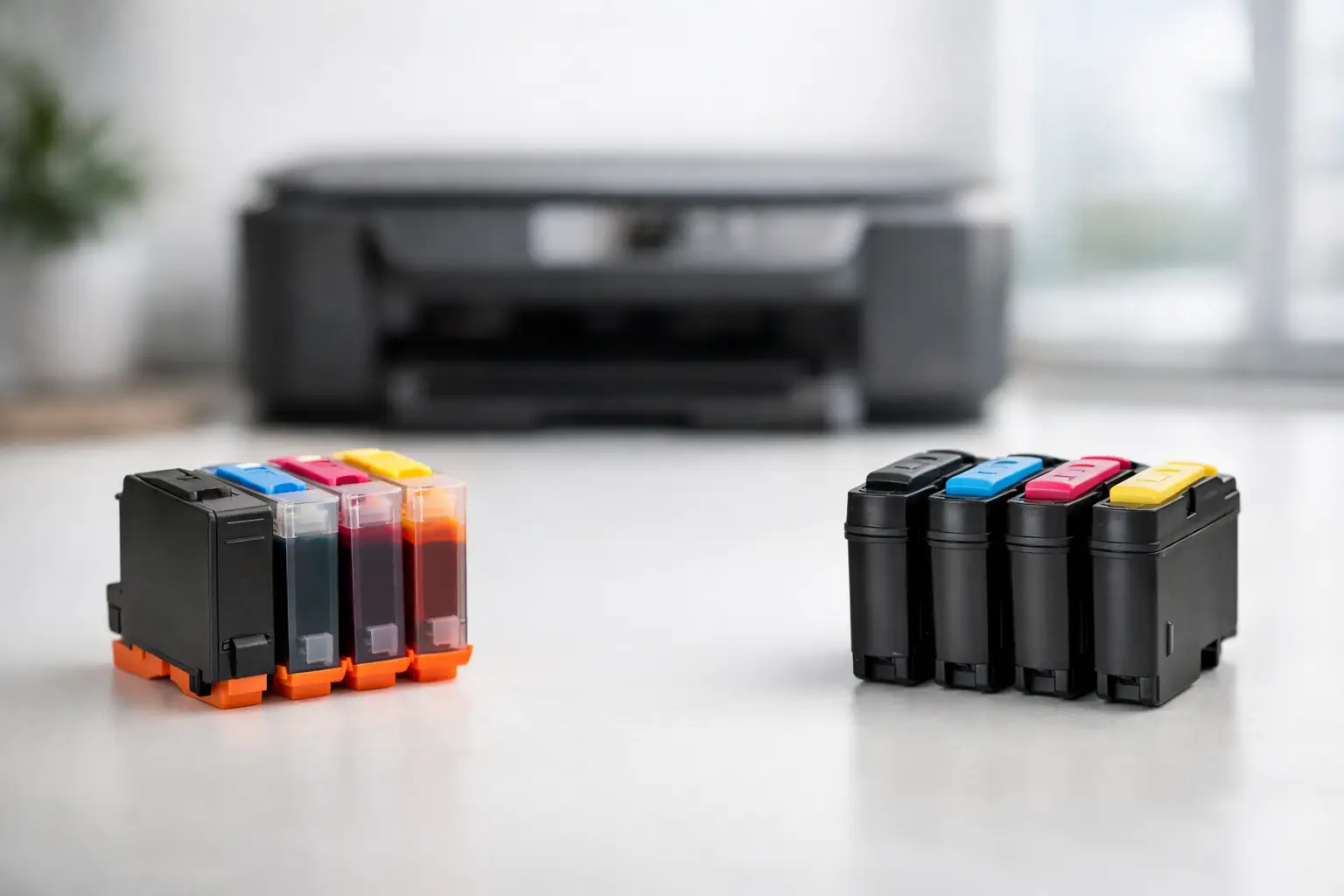
A printer can be inexpensive to buy and surprisingly costly to run. When a low-ink warning appears, the choice between compatible vs original cartridges can have a real effect on your print budget, especially if you print schoolwork, invoices, shipping labels, reports, or family photos every week.
Original cartridges are made by the same company that made your printer. Compatible cartridges are new replacement cartridges made by a third-party manufacturer to fit specific printer models. Both have a place, but they are not automatically equal in price, performance, or buying experience. The right option depends on what you print, how often you print, and how much flexibility you have in your supply budget.
Compatible vs Original Cartridges: The Main Difference
Original equipment manufacturer, or OEM, cartridges carry the printer brand name, such as Brother, Canon, Epson, or HP. They are designed and tested by that printer manufacturer for its own devices. This gives many buyers confidence, particularly when they need a familiar product and are working with a printer used for specialized color work.
Compatible cartridges are not refilled OEM cartridges. A quality compatible is a newly manufactured product designed to work with named printer models and use the correct cartridge shape, chip configuration, and ink or toner formulation. They are sold under a third-party brand rather than the printer manufacturer’s brand.
The most obvious difference is price. OEM cartridges often cost substantially more because you are paying for the printer brand, its research and development, packaging, distribution, and support structure. Compatible options are made to provide a more affordable replacement for routine printing, without requiring you to pay the premium OEM price each time a cartridge runs out.
That difference matters when your printer is part of daily life. A home office printing invoices, a student printing assignments, or a small business producing order forms can go through several cartridges in a year. Lower per-cartridge costs can make it easier to keep supplies on hand instead of waiting until printing comes to a stop.
Print Quality: What Can You Expect?
For standard documents, compatible cartridges can deliver sharp black text and clear color graphics that meet the needs of most homes and businesses. Letters, spreadsheets, forms, school projects, labels, and internal handouts do not usually require the same color precision as a professional photographic print.
OEM cartridges can be the better choice where exact color matching is essential. If you are producing client-ready marketing materials, fine-art photographs, archival prints, or proofs where a particular shade must match a brand standard, the printer manufacturer’s own ink may offer more predictable results. Paper choice, print settings, and monitor calibration also affect color, so the cartridge is only one part of the equation.
For everyday work, the useful question is not whether compatible cartridges can print. It is whether they can produce the quality you actually need at a cost that makes sense. In many cases, they can.
Toner users should think about page volume as well as appearance. A good compatible toner cartridge can be an economical option for black-and-white documents, while an OEM toner may be preferred for highly specific color output or manufacturer-controlled office environments. Always check the listed printer models before ordering, since cartridges that look alike are not necessarily interchangeable.
Reliability Depends on Where You Buy
The concern many buyers have is simple: will a compatible cartridge work properly in my printer? The answer depends heavily on the supplier and the product quality.
Very cheap, unverified cartridges can create problems such as poor page yield, streaking, leakage, error messages, or inconsistent color. That does not mean all compatible products perform poorly. It means cartridge quality varies, just as it does with many replacement products. Choosing a specialist supplier that clearly identifies compatible printer models and stands behind its products lowers the risk.
Before you purchase, confirm your printer’s full model number and your current cartridge number. The printer family name alone is not always enough. For example, two printers from the same product range may use different cartridge series. Checking the number printed on your old cartridge, printer display, or printer manual is a practical way to avoid ordering the wrong item.
It also helps to buy before your last cartridge is completely empty. Keeping a spare black cartridge or toner unit on hand is a simple way to avoid disrupted work, last-minute store runs, and expensive emergency purchases.
What About Printer Warranties?
Using a compatible cartridge does not automatically void a printer warranty. However, a printer manufacturer may decline to cover a fault if it can show that a non-OEM cartridge directly caused the damage. Keep receipts, follow installation instructions, and choose products from a seller with a clear return or replacement policy.
If your printer is under a service contract, leased through your workplace, or used in a tightly managed IT environment, check the agreement before changing cartridge types. Some arrangements specifically require OEM consumables. For a personally owned home or small-business printer, the decision is usually more straightforward.
Cost Per Page Is More Useful Than Sticker Price
The cheapest cartridge is not always the best value. A low purchase price is helpful, but page yield matters too. Page yield is an estimated number of pages a cartridge can print under standardized testing conditions. Your actual results will vary based on page coverage, color use, print settings, and the type of documents you produce.
A high-yield compatible cartridge can be a particularly good fit for people who print often. It may cost more than a standard-yield option upfront but reduce the cost per page over time. This is worth considering for offices producing invoices, packing slips, forms, and reports, as well as busy households with multiple students.
On the other hand, light users should avoid stocking up far beyond their needs. Ink cartridges can dry out if left unused for long periods, especially if the printer is rarely turned on. If you print only occasionally, buy the correct cartridge from a reliable source, run a small print job now and then, and keep the printer switched on according to its manufacturer guidance so it can perform normal maintenance cycles.
When Original Cartridges Make Sense
Original cartridges remain a sensible choice in several situations. Choose OEM supplies when exact color consistency is critical, when your printer is used for specialty media, when a lease or service agreement requires the brand’s own cartridges, or when you simply prefer to use the manufacturer’s consumables.
They can also be a convenient option if you need a cartridge immediately and have limited choices. The key is to recognize that convenience and brand familiarity often come at a higher ongoing cost.
When Compatible Cartridges Are a Smart Buy
Compatible cartridges are often the practical choice for budget-conscious printing. They suit routine home printing, school documents, home-office paperwork, general business printing, and label-making tasks where dependable results and lower running costs are the priority.
They are especially worth considering when you print regularly and want to reduce the cost of replacement supplies without replacing a printer that otherwise works well. At Inktoner Cartridge, customers can choose compatible ink, toner, drum units, and label tapes by printer brand and model, making it easier to find a suitable replacement without unnecessary guesswork.
A reliable compatible option should have clear compatibility information, sensible pricing, secure ordering, and a straightforward path to support if something is not right. Those details matter more than a dramatic discount from an unknown seller.
A Simple Way to Make Your Choice
Start with the work your printer needs to do. If it mainly produces documents, forms, labels, and everyday color pages, compatible cartridges can offer excellent value. If every print must meet strict color or production requirements, original cartridges may justify the additional cost.
Then verify the printer model and cartridge number, compare standard and high-yield options, and buy from a supplier that offers clear product details and return protection. The best cartridge is the one that fits your printer correctly, delivers the output you need, and keeps your printing costs manageable long after the printer leaves the box.