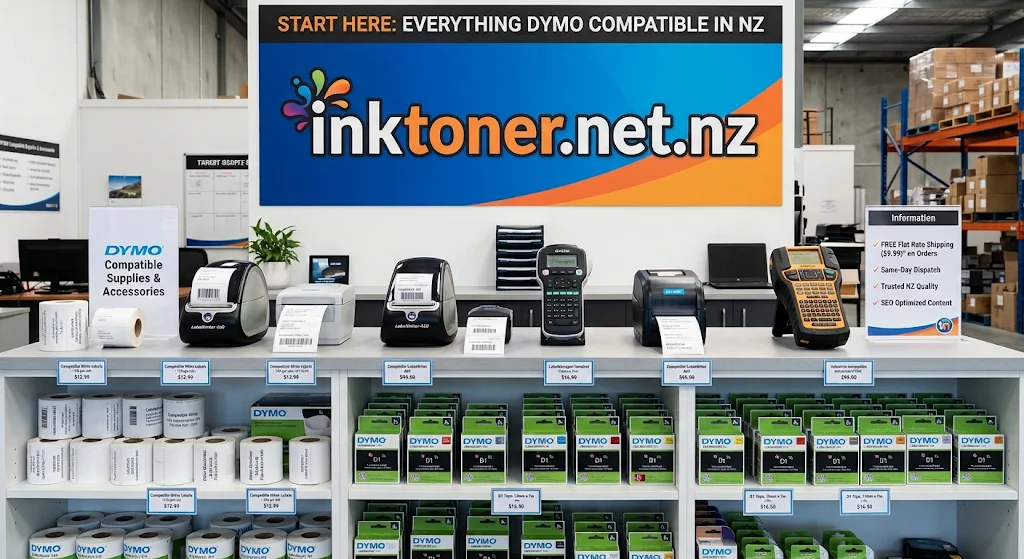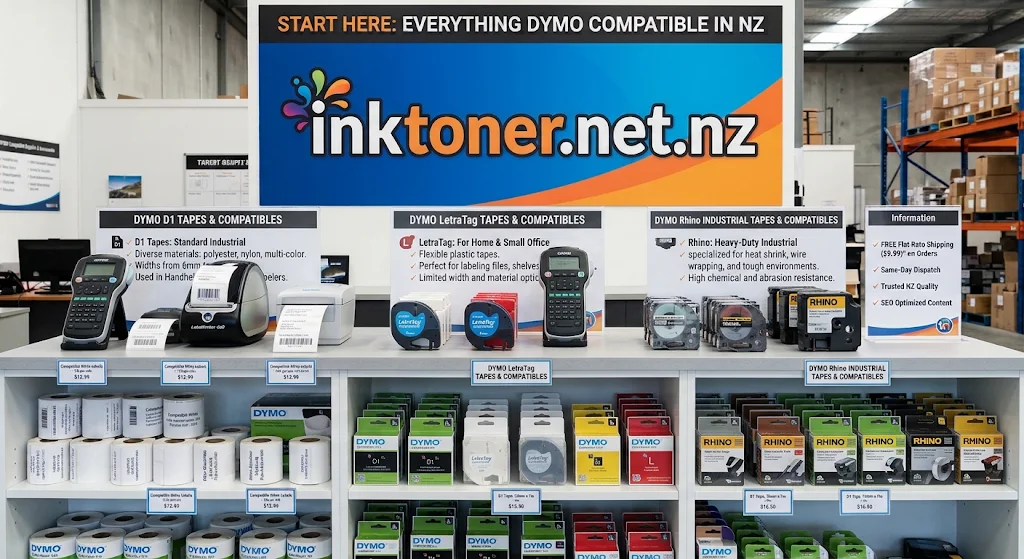
The Ultimate NZ Buyer’s Guide to DYMO Label Tapes. DYMO label tapes are not one universal product. D1, LetraTag and Rhino belong to different label-making systems and are designed around different types of work. Choosing the wrong family can mean a cassette will not fit, feed or perform as expected. This New Zealand buyer’s guide explains the differences in plain language and shows how to choose the right tape for home organisation, office administration, stock control, electrical work, workshops and other practical applications.
The three tape families at a glance
D1 is commonly associated with DYMO label makers used for everyday office and home labelling. LetraTag is a separate family aimed strongly at simple household and general organisation tasks. Rhino is associated with more demanding industrial identification work. The important point is that these families should not be treated as interchangeable just because they are all sold under the DYMO name. Always match the cassette to the exact device.
DYMO D1: everyday organisation
D1-style tapes are a practical choice when you want neat, readable labels for folders, drawers, cables, containers, shelves and office equipment. The correct width depends on the machine and the label layout you need. D1 is particularly useful where appearance matters because clean text and a consistent format can make an office or home storage system easier to maintain. Before buying, check the model and the supported width rather than assuming the widest tape will fit.
LetraTag: simple home labelling
LetraTag is often considered for household organisation because the system is designed for straightforward labels. Typical jobs include pantry containers, storage tubs, children’s belongings, craft supplies and household drawers. The best choice depends on the surface and whether you need a label that can be removed later. For home use, the visual system can be as important as the tape itself: consistent wording and placement make the whole storage area easier to use.
Rhino: industrial identification
Rhino is the family to consider when labels face tougher conditions. Electrical panels, cables, network installations, tools, bins, equipment and workshop assets may require stronger adhesion and more durable label materials. Industrial identification also benefits from clear conventions. A label should identify an item quickly and remain legible after handling. If the environment involves heat, moisture, abrasion, chemicals or outdoor exposure, choose a tape specifically rated for that situation rather than relying on a standard office tape.
How to avoid buying the wrong family
The safest method is a three-step check: identify the exact DYMO machine, identify the tape family it accepts, and then choose the required width and material. Do not rely on a listing title alone. If the seller provides a compatibility chart, compare your model number directly. When in doubt, take a clear photo of the existing cassette and compare the printed specification with the replacement listing.
D1 vs LetraTag vs Rhino for NZ jobs
For a home pantry, a simple LetraTag solution may be enough. For an office filing system or general asset labels, D1 may be more appropriate when supported by the device. For workshop, electrical or industrial identification, Rhino can make more sense because durability becomes a primary requirement. The right answer is therefore based on the job rather than the brand name. A cheaper standard tape can be false economy if it needs frequent replacement. The Ultimate NZ Buyer’s Guide to DYMO Label Tapes.
Buying for Auckland homes and businesses
New Zealand buyers should also consider supply continuity. If you use labels every week, choose a supplier with a clear product specification and predictable availability. Businesses should record the exact tape part number in their purchasing system so staff do not accidentally order a visually similar cassette. For home users, keeping one spare roll of the main size can prevent a small labelling project from being interrupted.
Quality, price and total value
A low price is attractive, but total value includes print quality, adhesive performance, length, waste and the time spent replacing failed labels. When comparing genuine and compatible products, calculate the cost per usable label rather than only the pack price. Read the compatibility information carefully and consider the environment. For a light-duty office label, an economical compatible option may be sensible. For an industrial cable label, durability can be worth paying more for.
Related Inktoner resources
If you are comparing label systems, see [Brother P-Touch vs DYMO]. For waterproof applications, read [Best Waterproof Label Tapes for Everyday Jobs]. For general supply buying, [Printer Supplies That Fit Your Budget and Printer] provides useful purchasing principles. [How to Find Cartridge Compatibility] reinforces the importance of model-specific checking, and [How to Reduce Printing Costs] explains why unit cost and waste should be considered together.
Related Inktoner guides:
Brother P-Touch vs DYMO,
waterproof label tapes,
how to check cartridge compatibility,
printer supplies on a budget, and
how to reduce printing costs.
Frequently Asked Questions
What is the difference between DYMO D1 and LetraTag?
They are different tape systems intended for different DYMO devices. Check the exact machine before ordering because their cassettes are not universally interchangeable.
Is Rhino better than D1?
Neither is universally better. Rhino is designed for demanding identification work, while D1 is commonly used for everyday labelling. Choose based on the environment and device.
Which DYMO tape is best for a pantry?
A suitable LetraTag tape can be a convenient home choice when compatible with the label maker. Focus on readability, adhesive suitability and easy replacement.
Can Rhino tapes be used for electrical labels?
Rhino products are commonly considered for industrial identification, including demanding cable and equipment labelling, but the exact tape should be selected for the specific environment and device.
For New Zealand buyers, the practical rule is simple: match the tape family to the exact label maker, then choose the width, finish, adhesive and durability level that fit the job. This avoids buying a roll that looks suitable but cannot be loaded correctly or does not provide the required performance.
A good label is more than readable text. It should remain attached, stay legible, suit the surface, and make sense for the person who will use the label later. Thinking about the environment before purchasing usually saves money because the right roll can prevent re-labelling and wasted material.
For Auckland homes and businesses, availability also matters. A low headline price is less useful if the product is difficult to replace when stock runs out. Keeping one spare roll of the most frequently used size is often a sensible approach for offices, workshops, stores and home organisation projects.
When comparing products, look beyond the brand name and check the actual tape specification. Width, colour combination, adhesive type, lamination, intended environment and printer compatibility are more useful decision points than price alone. This approach also makes it easier to compare genuine and compatible alternatives fairly.
For New Zealand buyers, the practical rule is simple: match the tape family to the exact label maker, then choose the width, finish, adhesive and durability level that fit the job. This avoids buying a roll that looks suitable but cannot be loaded correctly or does not provide the required performance.
A good label is more than readable text. It should remain attached, stay legible, suit the surface, and make sense for the person who will use the label later. Thinking about the environment before purchasing usually saves money because the right roll can prevent re-labelling and wasted material.